Neque porro quisquam est qui dolorem ipsum quia
How to Choose the Right Wood-Based Panel for Your Project
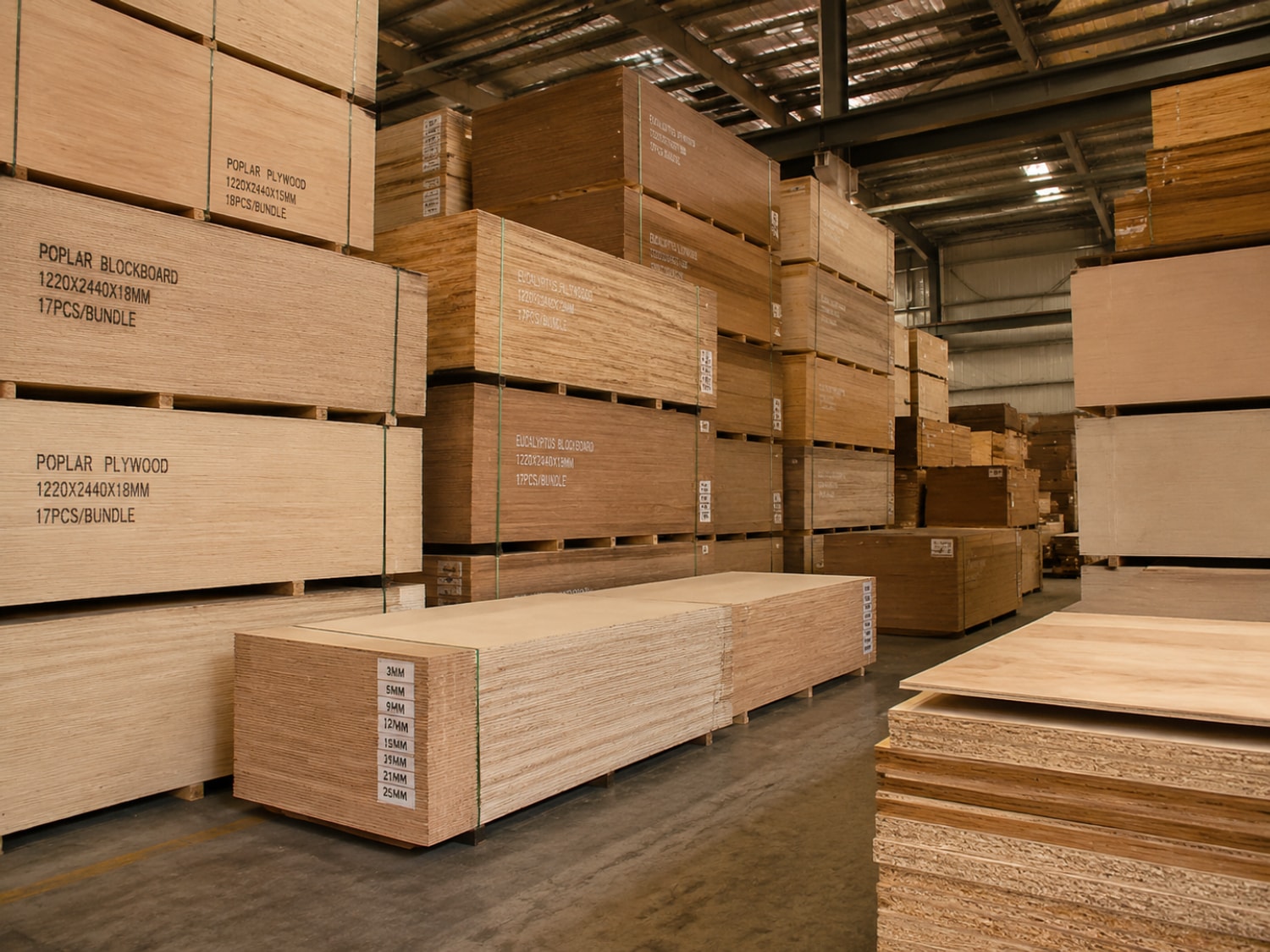
Selecting the right wood-based panel is one of the most important decisions in furniture manufacturing, interior decoration, and construction projects. Different panel types offer unique advantages in terms of strength, moisture resistance, surface finish, and cost efficiency. Understanding these differences can help buyers achieve better performance while controlling project budgets.
Understanding Common Wood-Based Panels
The global wood panel market offers several widely used products, each designed for specific applications and performance requirements.
Plywood
Plywood is manufactured by bonding multiple layers of wood veneer together with the grain direction alternating between adjacent layers. This construction provides excellent dimensional stability and strength.
Common applications include:
- Furniture manufacturing
- Cabinet production
- Wall panels
- Flooring substrates
- Construction formwork
MDF (Medium Density Fiberboard)
MDF is produced from refined wood fibers bonded under heat and pressure. Its smooth and uniform surface makes it ideal for decorative applications.
Typical uses include:
- Painted furniture
- Decorative wall panels
- Interior doors
- Moldings and trims
Particle Board
Particle board is manufactured from wood particles and resin. It offers a cost-effective solution for many furniture applications.
Popular applications include:
- Ready-to-assemble furniture
- Shelving systems
- Office furniture
- Interior cabinetry
Comparing Key Characteristics
The following table provides a general comparison of the most commonly used wood-based panels.
| Property | Plywood | MDF | Particle Board |
|---|---|---|---|
| Strength | High | Medium | Medium-Low |
| Moisture Resistance | Good | Moderate | Limited |
| Surface Smoothness | Moderate | Excellent | Good |
| Machining Performance | Excellent | Excellent | Good |
| Weight | Medium | Heavy | Medium |
| Cost | Higher | Moderate | Lower |
| Typical Applications | Construction, Furniture | Decorative Furniture | Budget Furniture |
Factors to Consider Before Purchasing
Choosing the right panel requires evaluating several project-specific factors.
Environmental Conditions
Projects exposed to humidity or varying temperatures require materials with enhanced moisture resistance.
For example:
- Kitchens often benefit from moisture-resistant MDF or plywood.
- Exterior applications typically require waterproof plywood.
- Dry indoor environments can utilize standard particle board effectively.
Surface Finish Requirements
The desired appearance significantly influences panel selection.
If the product requires:
- High-gloss painting → MDF is often preferred.
- Natural wood veneer → Plywood provides an excellent substrate.
- Melamine lamination → Particle board and MDF are commonly used.
Structural Performance
Load-bearing applications generally require stronger materials.
Examples include:
- Heavy-duty shelving
- Flooring systems
- Commercial furniture
- Structural construction elements
In these situations, plywood typically offers superior performance.
Sustainability and Certification
Environmental responsibility has become increasingly important throughout the timber supply chain.
Common Certifications
Many international buyers look for certified products to support sustainable sourcing practices.
| Certification | Purpose |
|---|---|
| FSC | Promotes responsible forest management |
| PEFC | Supports sustainable forestry practices |
| CARB P2 | Controls formaldehyde emissions |
| EPA TSCA Title VI | Regulates wood product emissions in the U.S. |
| CE Marking | Indicates compliance with European standards |
Benefits of Certified Panels
Certified wood-based panels can provide:
- Improved market access
- Regulatory compliance
- Enhanced brand reputation
- Support for sustainability initiatives
Conclusion
No single wood-based panel is suitable for every application. Plywood delivers superior strength and durability, MDF offers outstanding surface quality for decorative projects, and particle board provides excellent value for cost-sensitive applications.
By carefully evaluating performance requirements, environmental conditions, finishing needs, and certification standards, buyers can select the most suitable panel solution for long-term project success.

About the Author: Beijing Huiju
HJ Trading is a professional supplier and exporter of wood-based panel products, serving customers worldwide with reliable sourcing solutions and consistent product quality. Our team shares industry knowledge, technical insights, market trends, and practical purchasing guidance to help manufacturers, distributors, and project contractors make informed decisions.
Share
Start Your Project With Us Today
Ask for samples & quote. We support customized solutions for your needs.
Related Post
-
Neque porro quisquam est qui dolorem ipsum quia
How to Choose the Right Wood-Based Panel for Your Project Selecting the right wood-based panel is one of the most important decisions in furniture manufacturing, interior decoration, and construction projects. Different panel types offer unique advantages in terms of strength, moisture resistance, surface finish, and cost efficiency. Understanding these differences can help buyers achieve better… -
Neque porro quisquam est qui dolorem ipsum quia
How to Choose the Right Wood-Based Panel for Your Project Selecting the right wood-based panel is one of the most important decisions in furniture manufacturing, interior decoration, and construction projects. Different panel types offer unique advantages in terms of strength, moisture resistance, surface finish, and cost efficiency. Understanding these differences can help buyers achieve better… -
Neque porro quisquam est qui dolorem ipsum quia
How to Choose the Right Wood-Based Panel for Your Project Selecting the right wood-based panel is one of the most important decisions in furniture manufacturing, interior decoration, and construction projects. Different panel types offer unique advantages in terms of strength, moisture resistance, surface finish, and cost efficiency. Understanding these differences can help buyers achieve better… -
Neque porro quisquam est qui dolorem ipsum quia
How to Choose the Right Wood-Based Panel for Your Project Selecting the right wood-based panel is one of the most important decisions in furniture manufacturing, interior decoration, and construction projects. Different panel types offer unique advantages in terms of strength, moisture resistance, surface finish, and cost efficiency. Understanding these differences can help buyers achieve better…